
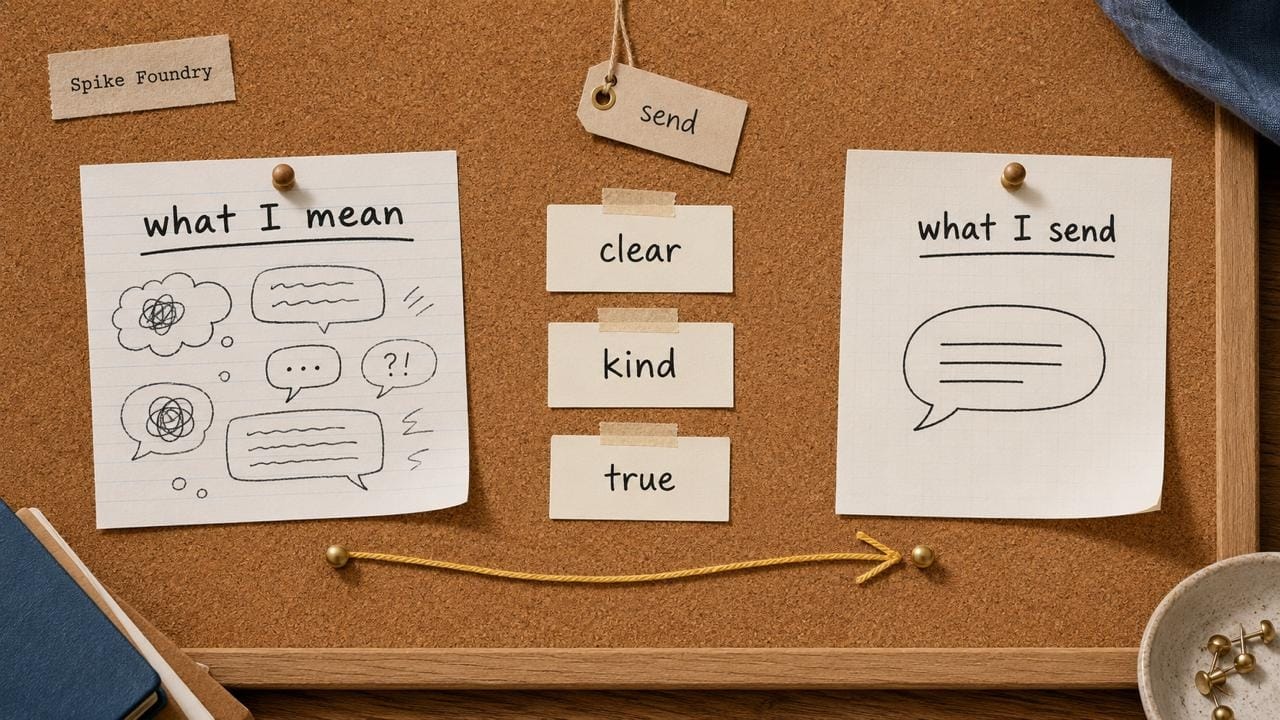
Sometimes the hard part is not finding the words. It is surviving the moment right before you use them.
You can know exactly what you mean and still freeze.
The message is sitting there. The words are not terrible. Nothing in it is obviously wrong. But your thumb hovers over send like the button is wired to something larger than a conversation.
So you reread it. You make it softer. Then clearer. Then warmer. Then shorter. Then you add one sentence because now it sounds cold. Then you delete that sentence because now it sounds needy.
At some point, you are no longer editing the message. You are trying to edit the risk.
The gap
There is a weird gap between knowing what to say and actually saying it.
Most advice treats that gap like a wording problem. It says: use better phrasing, use a template, keep it short, be direct, say what you mean.
That advice is not wrong. It is just incomplete.
Because a lot of the time, you already know the clean version. You know the respectful version. You know the version that would make sense if somebody else showed it to you.
The problem is not only language. The problem is what the language might cost.
- What if they misunderstand?
- What if they think you are upset?
- What if they do not respond?
- What if you sound too cold?
- What if you sound like you care too much?
That is where the gap lives.
It shows up everywhere
It shows up in texts, of course. The message you keep rewriting. The reply you delay because you need the tone to be exactly right. The boundary you turn into a paragraph because a clean no feels too exposed.
But it is not only texting.
It shows up at work when you need to ask the simple question everyone is avoiding.
It shows up when a process is broken, but saying that out loud means someone may feel accused.
It shows up when you are tired, holding a baby, answering one more message, and trying not to sound like the version of yourself that has not slept enough.
It shows up in all the small places where communication is not just information. It is a relationship, a consequence, a possible misunderstanding.
The review board in your head
Overthinking often feels like preparation, but sometimes it turns into an internal review board.
You become the writer, the reviewer, the stakeholder, the risk manager, and the person being evaluated.
You prepare a defense for a reaction nobody has had yet.
That is how a normal message becomes six paragraphs. Not because you had six paragraphs to say, but because you wanted to be impossible to misunderstand.
The difficult truth: you cannot be impossible to misunderstand.
You can be honest. You can be clear. You can be kind. You can be brief. You can give the message a better chance.
But you cannot control every possible reading of it.
A better standard
The standard cannot be “Will this land perfectly?”
That standard will keep you trapped.
A better standard is:
Is this clear enough, kind enough, and true enough to send?
Not perfect. Enough.
Clear enough means the person can understand what you are saying without decoding you.
Kind enough means you are not using sharpness as armor.
True enough means you are not pretending, performing, or negotiating against yourself before the other person has even replied.
Small courage, not perfect confidence
There is a kind of confidence that gets sold as loud, certain, unbothered.
I do not think most useful communication works that way.
Most of it is smaller than that. It is the courage to ask for clarification. The courage to say no without writing a closing argument. The courage to send the honest sentence before panic turns it into a policy document.
Sometimes the win is not sounding fearless. Sometimes the win is sounding like yourself while your nervous system is trying to turn a text into a weather event.
The practical move
When you feel the gap, do not start by rewriting the whole message.
Ask three questions:
- What am I actually trying to say?
- What am I afraid they will think?
- What can I remove that is only there to manage that fear?
That third question does a lot of work.
It does not make the conversation risk-free. Nothing does. But it helps you separate the message from the panic attached to it.
The gap between knowing what to say and actually saying it may never disappear completely.
That is fine.
Communication is not just wording. It is courage plus clarity, repeated in small moments until you trust yourself a little more.
— The Operator